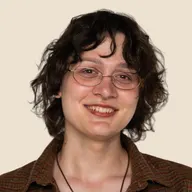
Hi, I’m Michaela.
I research eye-tracking. Where people look. How the eyes alone can make things happen on a screen.
I want more people to know about it, and I want the tools I make to work for complete beginners too.
What eye-tracking is
Eye-tracking measures where a person looks, for how long and in what order. A camera watches the eyes tens to thousands of times a second.
Looking at a still picture, the eye does not glide. It rests, jumps, and rests again. A rest is called a fixation, a jump is a saccade, and the whole route is a scanpath.
From such a route you can tell what people look at, what they pass over and where they hesitate. It helps make maps and websites clearer. We are exploring how it could help children with dyslexia. And it lets you control things just by looking at them.
Steering by sight
Seeing where I look felt like magic. Controlling something with my eyes, even more.
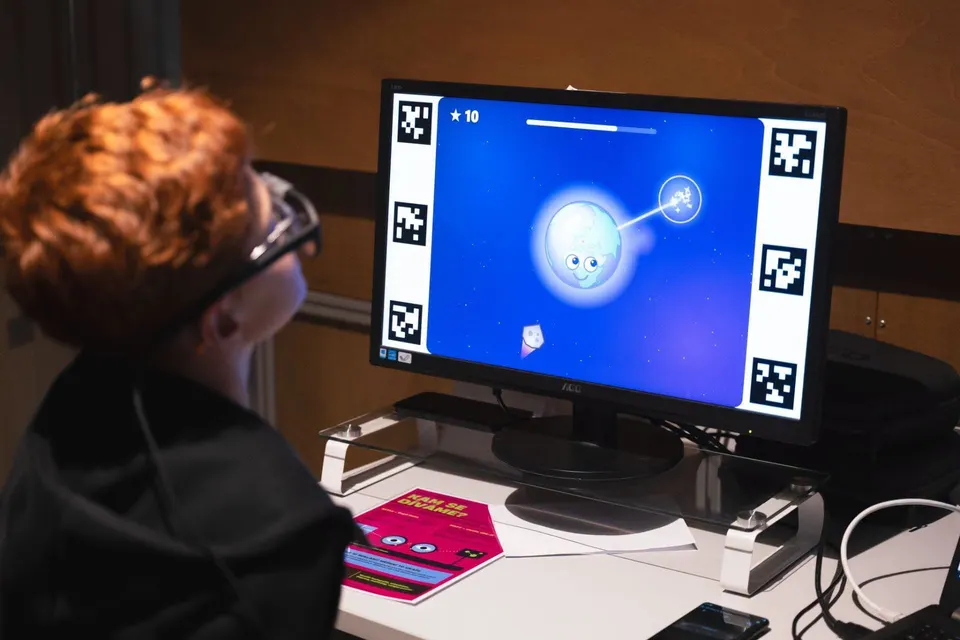
In the photograph at the top of this page a child shoots down asteroids just by looking at them. My doctoral research does the same with maps: you zoom, move and point with your gaze.
GazeDeck takes it beyond the screen. With eye-tracking glasses it knows where you look on a monitor, a projection wall or even a printed map, and several people can look at once.
Tools I make
I build my tools so that anyone can start with them, with no licence to buy first.
GazePlotter is free and open source. No installation, no account, no code to write. You open your data in the browser and start, and the data never leave your computer.
 GazePlotter
Free browser app for visualising and analysing AOI-based eye-tracking data.
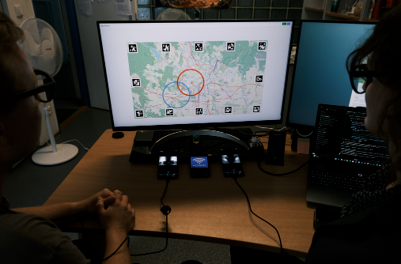 GazeDeck
Gaze interaction with maps on any surface using mobile eye-tracking glasses.
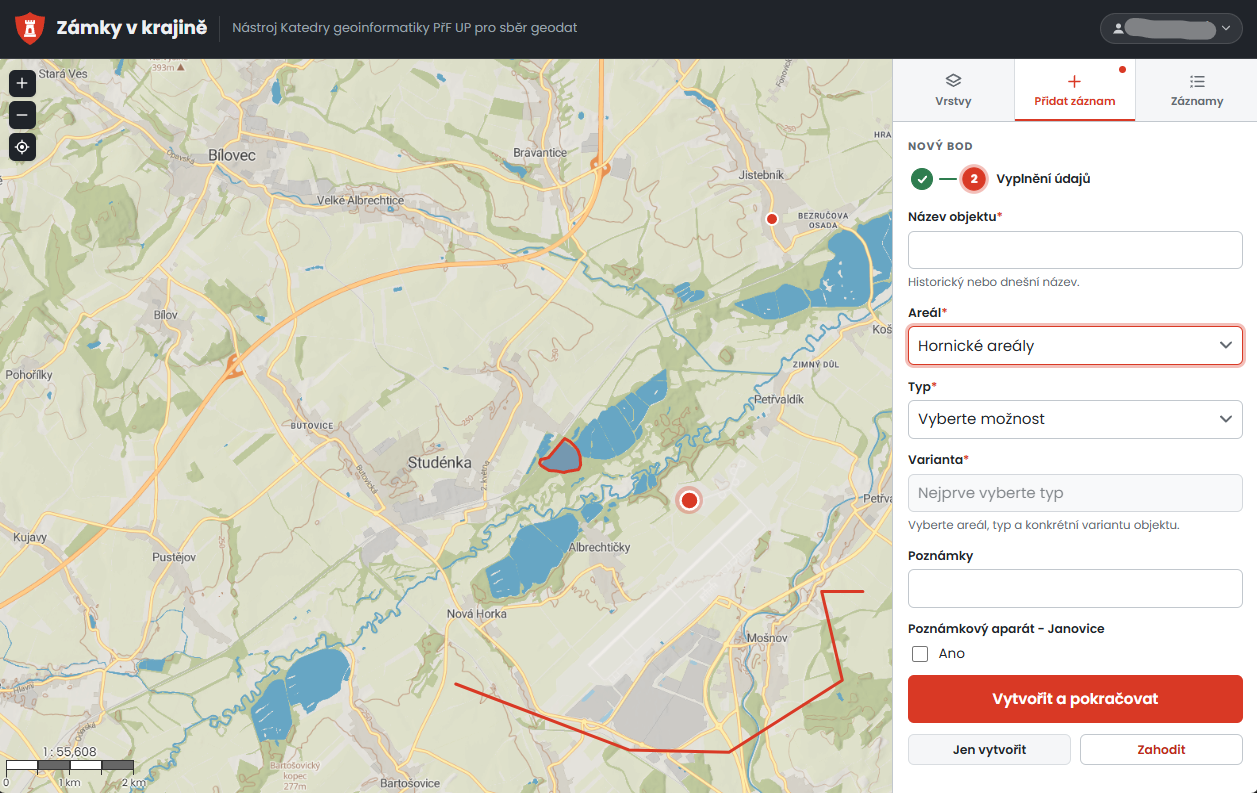 Geodata Collector
Internal web tool for collecting geometries from historical and georeferenced maps.
What I have written and said
Everything I have published and presented is listed in full, one click away.
Three recent papers:
- GazePlotter: An open-source solution for the automatic generation of scarf plots from eye-tracking data. Behavior Research Methods, 2026.
- Evaluating User Interaction with Cartographic Visualizations on Mobile and Desktop Platforms. International Journal of Human–Computer Interaction, 2026.
- Visualization Lenses for Time-Binned AOI Occupancy in Eye-Tracking Analysis. Proceedings of the 2026 Symposium on Eye Tracking Research and Applications, 2026.
I also teach at the Department of Geoinformatics: usability and eye-tracking, and programmatic data processing. The rest is in my curriculum vitae.
Away from the desk
When I am not working, I go to the hills. I like silence and time to think, and that is where I find both, most of all in autumn.
My work actually started far from any laboratory. As a child I loved the maps drawn inside fantasy books, where a whole magical world fits on a single page. They are the reason I went on to study maps, and later the eyes that read them.

Working together
I like working on research projects with other people. If you are planning one, do write to me. I cannot promise that I will have the time, but please ask anyway.
Commercial work is welcome too. It goes through ETEBOR, a competence centre of Palacký University that runs eye-tracking studies for companies: how people really see a website, an advert, a product or a space. There I analyse the data and work out what they mean.